
Convert Word equations to MathType: OMML steps and troubleshooting
For existing Word equations (OMML), a supported Word and MathType 7 desktop installation provides MathType → Convert Equations → Word 2007 and later (OMML) equations → MathType equations (OLE objects). Convert a small selection in a copy of the document first, check the result, then process the whole document if needed.
This guide covers existing Word equations, including native equations in ordinary Word files exported from Doc2X. A PDF or equation screenshot needs recognition first. If you already chose Doc2X's Word MathType export, check the object types before converting anything again.
Choose the path for your equation type
| What you have | What to do |
|---|---|
| Native Word equations with editable fractions, scripts and other structures | Use the OMML-to-MathType steps below. |
| Existing MathType equation objects | Open and check them in a compatible MathType environment; converting them to the same type is usually unnecessary. |
| Ordinary screenshots or scanned equation images inserted into Word | These images have no OMML structure to convert. Use equation recognition and review, check the content, then export. |
| Parsed PDF or image content that needs a Word MathType file | Choose the corresponding Doc2X export option; see Word, WPS and export format selection. |
Doc2X Word MathType export converts supported equations to MathType and leaves unsupported ones as Word equations. A single DOCX may contain both types. The desktop add-in works inside Word; it is a different workflow from uploading a PDF for recognition.
Requirements
- These instructions cover Microsoft Word on Windows with the MathType 7 desktop add-in, rather than Word in a browser. MathType for Microsoft 365 uses a different interface.
- Confirm that Word has a MathType tab with Convert Equations. Check version compatibility in the official MathType documentation.
- The existing screenshots below show Windows 10 22H2 and Office Home and Student 2019. Other versions may look different; these images do not establish compatibility with every version.
- Save a separate copy before conversion. Check equations, numbering and adjacent text before replacing your working document.
Convert equations with the MathType add-in
1. Select representative equations in a copy
Start with a short selection containing a fraction, scripts or a matrix. Open MathType → Convert Equations. Check the current selection before applying conversion to the entire document.

2. Choose the source, output and range
- Under equation types to convert, select Word 2007 and later (OMML) equations.
- Choose MathType equations (OLE objects) as the output.
- Check the range: use Current selection for the initial check, or Whole document when ready to process the full document. Select other source types only when you intend to convert them.
- Click Convert. Use Prompt before converting each equation if you want to review each conversion choice.

This existing screenshot shows whole-document conversion with other source types also checked. For native Word equations, choose OMML according to your document; you do not need to copy every checkbox in the image.
3. Check the conversion count and editing result
Read the reported number of converted equations. Then double-click representative equations and confirm they open for editing in the intended MathType environment. Check scripts, radicals, matrix rows and columns, special symbols, numbering and spacing. Similar appearance alone does not prove that the equation structure is correct.

If no equations were converted, check the selection and source type. Selecting OMML does not turn an ordinary screenshot into an editable equation.
Installation and add-in checks
If installation is needed, use the official MathType download entry, choose a version suitable for your environment and check its license or trial terms. MathType is third-party software; Doc2X membership does not include its software license.
If the MathType tab is missing, check that the appropriate desktop add-in is installed and compatible with your Office version, then follow the vendor's installation instructions. Installing the Microsoft 365 add-in does not necessarily provide the MathType 7 conversion menu shown here.
Handle a blocked macro prompt
Do not treat Enable all macros as a general prerequisite for equation conversion. Microsoft explicitly discourages that setting because it runs all macros without confirmation.
Check which file or add-in is blocked, its source, the official MathType installation and your Word version. Follow Microsoft's macro guidance when assessing a trusted document or signed publisher. On a managed work or school computer, ask the administrator to review policy rather than lowering global protection to bypass it.
Check the converted document
- Keep the original and review the converted copy before replacing your working file.
- A document can contain native Word equations, MathType objects and ordinary images. Check each type separately.
- For WPS, see the separate WPS and MathType compatibility guide. Do not assume the Word add-in menus and steps apply unchanged.
Equation types: MathType objects, preview images and ordinary pictures
A MathType equation that looks like an image in a preview has not necessarily lost its object data. An equation object and its display image can coexist. On 2026-10-13, we checked two existing native downloads from the same self-authored six-equation Markdown source and created a separate local image-only control. No new recognition or product export was performed.
| Fixed sample | Native Word equations (OMML) | MathType objects | Object previews / standalone images |
|---|---|---|---|
| Native ordinary Word | 6 | 0 | 0 / 0 |
| Native Word MathType | 0 | 6 | 6 / 0 |
| Local image-only control, included in the review ZIP | 0 | 0 | 0 / 6 |
Each native Equation.DSMT4 object links to internal data and identifies its display shape through ShapeID. Six PNGs therefore do not mean six additional equations or an image-only document. An isolated .bin file is insufficient too: check whether the document actually references it.
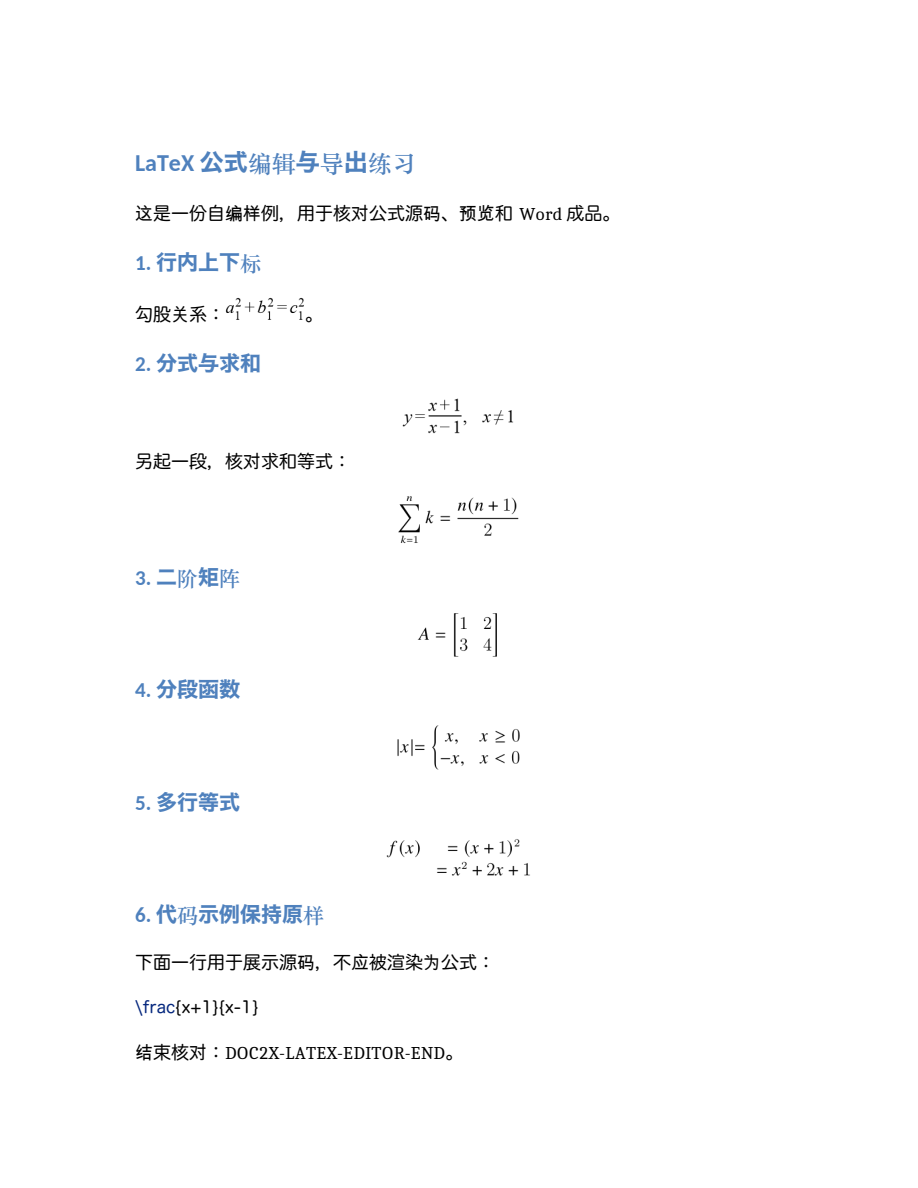
Local preview of the native MathType DOCX. The image shows appearance; object counts were checked separately in the file.
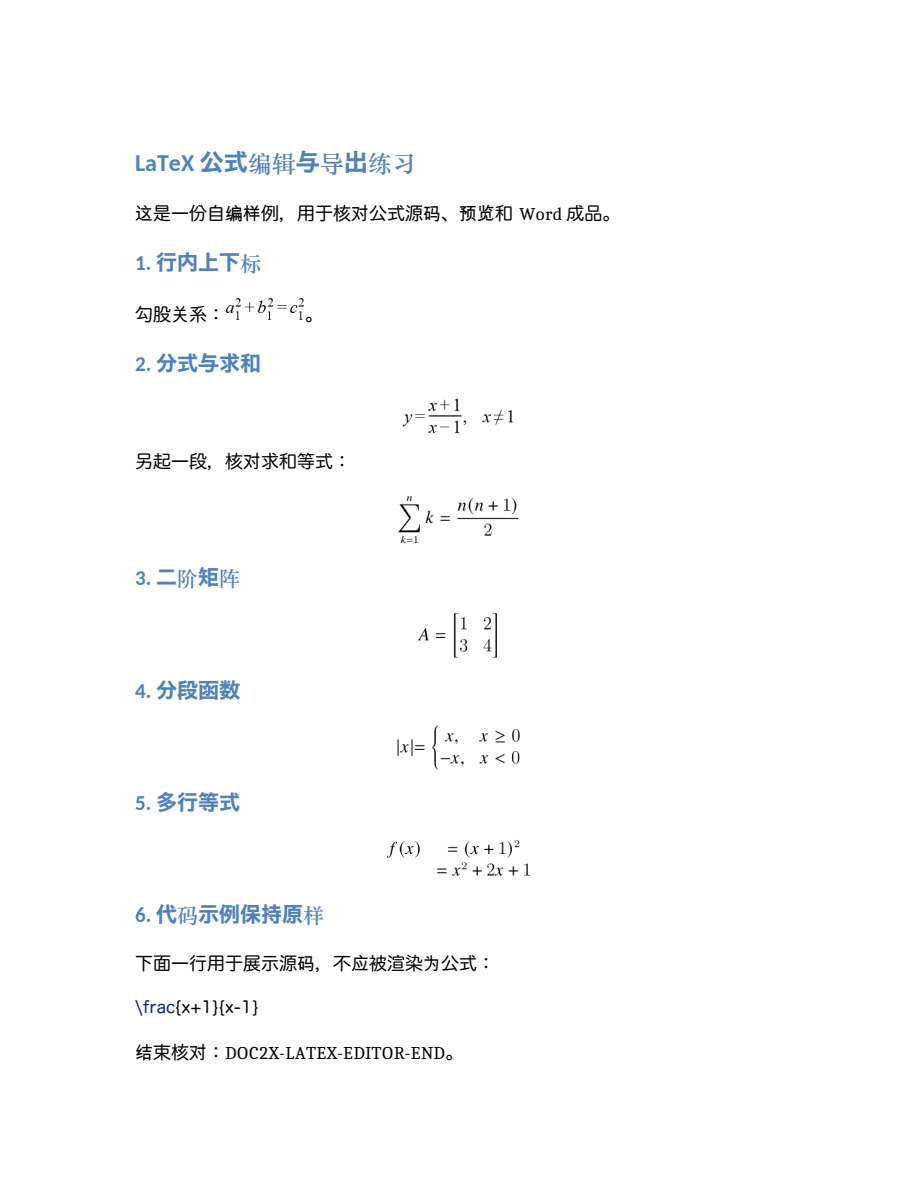
The local image control removes six OLE elements, relationships and payloads, retaining the display shapes as pictures. Body text and all six PNG bytes stay intact. This is a deliberately constructed explanation, not a failed Doc2X export. The local previews look similar but are not pixel-identical. The authored sample text is in Chinese.
Download the three DOCX files, source, three local PDFs and read-only verifier. After extracting the complete bundle, run with an available Python 3:
python3 inspect_samples.pyThe script checks the three fixed sample hashes and reads main-document object, payload and preview relationships. It uses only the standard library, makes no network requests, executes no embedded objects and changes no files. It does not repair or convert equations; do not rename your own document to impersonate a sample. See Microsoft Open XML's OLEObject reference for the type and relationship fields.
The images and PDFs were rendered locally with LibreOfficeDev 26.8 and existing fonts supplied only to that process. This review did not test editing in Word, WPS or a MathType add-in. Keep originals and try editing representative equations in a copy using the intended application, then save and reopen it. If only images remain, return to a clear source or mathematical source text. If object data remains, check application and add-in support before deciding that recognition must be repeated.
Frequently asked questions
Can Word equations be converted to MathType in a batch?
A MathType 7 Word add-in that supports this conversion offers whole-document and current-selection ranges. Back up the file and test representative equations first. Complex equations may still require correction.
Why does the conversion count show zero?
Check the range and select a source type matching the original equations. Ordinary screenshots require recognition first. Existing MathType objects are also different from native Word equations awaiting OMML conversion.
Can Doc2X export directly without installing MathType first?
For supported v3 parsing results, check the Word MathType file export option and the current task and account requirements. Supported equations become MathType objects; others remain Word equations. This does not directly rewrite every object in an existing Word file. Editing the exported objects still depends on your target software environment. See export format selection.
What if symbols are missing or an equation cannot be edited?
Keep the original, confirm the object type and check Word and MathType compatibility. Inspect one affected equation in a copy. If Greek letters or operators disappear, check whether the original used characters from Word's Insert Symbol dialog with a different encoding. Replace them with the intended symbols from the Equation tab, then test the affected equation. See MathType's official conversion troubleshooting. Visual appearance alone is not a sufficient success check.
Must I enable all macros when a macro is blocked?
No. Enabling all macros is not a general solution. Use the macro-prompt checks above to review the source, installation and management policy.