
Doc2X Translation Glossary Guide
This document provides detailed instructions on how to import and use CSV-format translation glossaries in Doc2X, helping you customize the translation effects of professional vocabulary.
Currently, each glossary supports a maximum of 500 terms.
Create, import, edit and use a glossary
- Sign in to the account that owns the glossary. Open avatar → Account management → Translation glossary, or Use glossary → Custom in translation settings.
- Click Add glossary and enter a name. Up to five glossaries are supported; check the existing count if the button is disabled.
- Use Add term to enter source text, translation and both languages, or Import CSV to select a file prepared with the template below. Check the imported preview row by row; selecting a file does not save it.
- Imported rows plus existing undeleted entries can total at most 500. Excess entries are omitted. Convert XLSX templates to CSV first. Avoid commas and cell line breaks inside terms: compatibility with complex quoted CSV is not guaranteed.
- Confirm the name and entries, then confirm the modal. Check the new glossary and rows in the list; reopen the glossary page if needed before creating another copy.
- Click the header's Edit glossary icon to change text or languages, add terms or mark rows for deletion. Complete required fields and confirm. Check the list after Submission completed; No edits made means no changes were submitted.
- Return to document translation settings, open Use glossary and select the saved glossary. Verify its name, target language, model and quota before starting. Do not use a glossary clears the selection.
- After translation, find a sample term that actually occurs in the source and matches the language direction, then check its translation. Saving a glossary does not automatically redo an existing result.
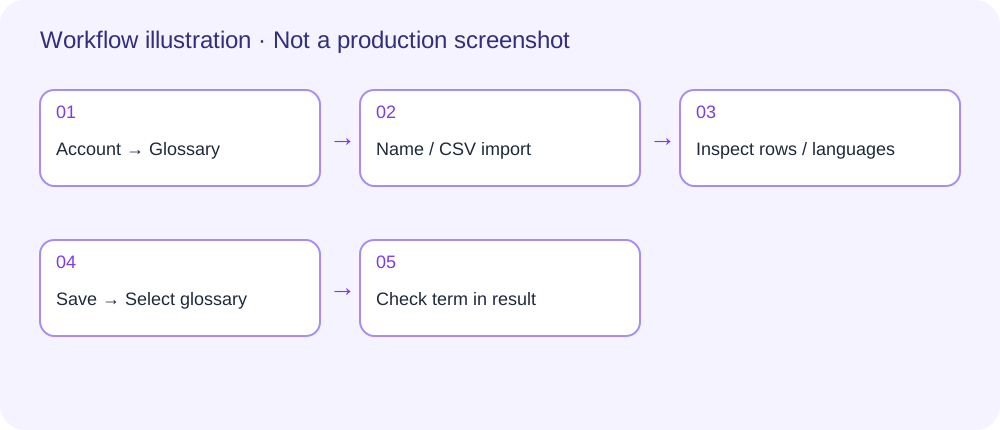
Workflow illustration, not a production screenshot. Inspect the import preview and translation result separately.
Existing glossaries have no rename, export or share control. Deleting a whole glossary requires irreversible confirmation; check its name first. Canceling edits does not submit them. For garbled or failed imports, check CSV encoding and separators. After a failed submission, reopen the glossary to inspect saved rows before retrying to avoid duplicates. Select the new account's glossary after switching accounts; an unloaded list does not establish that a glossary was deleted.
Template Content Format
Simply put, it's a table file where the first row contains headers, and each subsequent row contains terms to be translated:
source,target,src_lang,tgt_lng
车辆制动定速巡航系统,CCS,zh,en
Header Field Explanation
From left to right:
| Field Name | Description | Required | Default Value |
|---|---|---|---|
| source | Source text | ✅ Required | - |
| target | Translated content | ✅ Required | - |
| src_lang | Source language | ⭕ Optional | English |
| tgt_lng | Target language | ⭕ Optional | Chinese |
Language Code Reference Table
| Display Name | Code | Example |
|---|---|---|
| English | en | Use en for English |
| Chinese Simplified | zh | Use zh for Chinese |
| Français | fr | Use fr for French |
| 日本語 | ja | Use ja for Japanese |
| Русский | ru | Use ru for Russian |
| Português | pt | Use pt for Portuguese |
| Español | es | Use es for Spanish |
| Deutsch | de | Use de for German |
| 한국어 | ko | Use ko for Korean |
| العربية | ar | Use ar for Arabic |
Important Notes
Separator Requirements
- ✅ File must use English comma separator (
,) - ❌ Chinese comma (
,) will cause errors!
- ✅ File must use English comma separator (
Language Code Standards
- Language codes must strictly follow the 2-letter abbreviations in the table
- Case-sensitive, please use lowercase
Simplified Format
- If translating from English to Chinese, you can omit the last two columns:
csvsource,target CCS,车辆制动定速巡航系统File Saving Recommendations
- When saving files, it's recommended to use Notepad or professional CSV editors
- ❌ Avoid using Excel's automatic formatting
What to do if the downloaded template appears garbled when opened
- When opening CSV files with Excel, it usually defaults to GBK or other encodings. You can use Excel's import function and select UTF-8 encoding to avoid garbled text
- When saving with Excel, please ensure you save as CSV with UTF-8 encoding
Frequently Asked Questions
Q: Can I import multiple languages at once?
A: Yes! For example, you can have both Chinese-to-English and French-to-German translations in the same file.
Q: What if I write the wrong language code?
A: The system will prompt an error. Please check against the code table above.
Q: What's the maximum length of a glossary?
A: There's no limit on CSV file content length. However, Doc2X glossaries have a maximum of 500 entries. Content exceeding this limit in the CSV file will not be added to the glossary.
Complete Example
Here's a complete example of a multilingual translation glossary (example.csv):
source,target,src_lang,tgt_lng
Hello,你好,en,zh
Bonjour,早安,fr,zh
こんにちは,Hello,ja,en
Example Explanation
- Row 1: English "Hello" translated to Chinese "你好"
- Row 2: French "Bonjour" translated to Chinese "早安"
- Row 3: Japanese "こんにちは" translated to English "Hello"